Carbon DLS, SLA and PolyJet resins
3D Printed Resins
DLS 3D printing Resins
SLA 3D Printing Resins
PolyJet 3D Printing Resins
STEP | STP | SLDPRT | STL | IPT | 3MF | 3DXML | PRT | SAT files and more!
Share drawings, sample photos, dimensions, or project notes and our team will follow up with a manufacturing review.
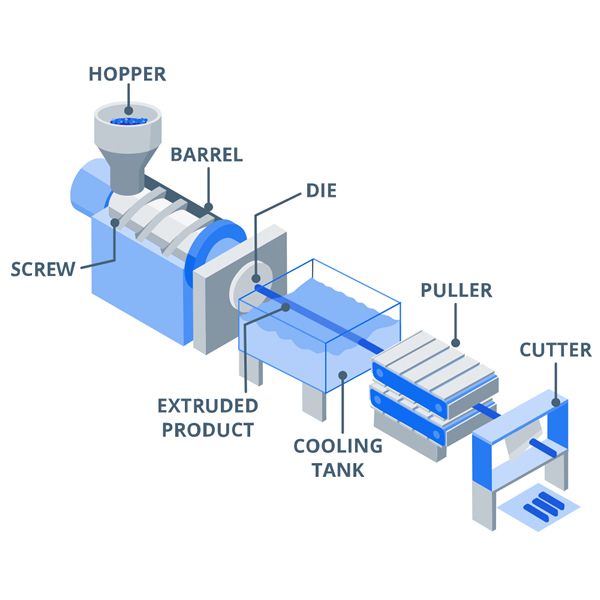
Plastic extrusion is a continuous forming process that converts thermoplastic pellets into linear profiles with consistent cross-sections. At production start, a hopper feeds pellet material into a rotating screw within a heated barrel — a principle similar to injection molding. As the screw rotates, molecular friction within the thermoplastic material intensifies, progressively raising temperature and pressure until the material is fully molten and flows well.
The melt is then pushed through a filter to remove impurities, and extruded through a die matched to the target cross-section profile to ensure uniform dimensions. The extrudate is pulled out of the die at a constant rate, sized through cooling (typically water cooling), then cut to standard lengths for distribution.
Extruded profiles often feature closed cross-sections, with tubing products being typical examples. The internal cavity is called a lumen, which can be divided into multiple independent channels as needed, achieving space partitioning while maintaining consistent wall thickness. KH-TAT supports multi-lumen extrusion structures with up to 4 lumens. Plastic extrusions play a foundational role in construction, municipal, telecommunications and many other industries.
Through KH-TAT custom plastic extrusion solutions, designers can leverage custom profiles and colors to precisely obtain continuous profiles meeting functional requirements.
After uploading design files, the system instantly provides estimated cost and lead time, along with material, Surface Finish and packaging options.
Leveraging our integrated manufacturing network, we effectively shorten production and logistics cycles. Standard, expedited and economy shipping options are available to suit different project timelines.
Part & Tooling Cost Advantages
Smart profile design reduces multi-part assembly needs, lowering overall project costs. Extrusion offers significant economies in high-volume production, especially for plastic parts where subtractive methods would be too costly. With relatively simple tooling structures, tooling costs are 80-90% lower than injection molding or die casting, making it the preferred choice for high-volume, low-cost applications.

Upload your files to the Xometry Quote Engine and configure your project. Our team will consult with you to ensure your specifications, lead time, and price fit your project needs. We will provide a DFM report for approval before kicking off tooling.

After your project is kicked off, we build a high-quality extrusion die. Once the tooling is created, we will run and send out part samples for approval.

Once you're satisfied with your samples, we will move forward with production and deliver the parts. Rest easy knowing Xometry is handling supplier management and logistics throughout the process. You own your tooling and can easily re-order as needed to meet demand.
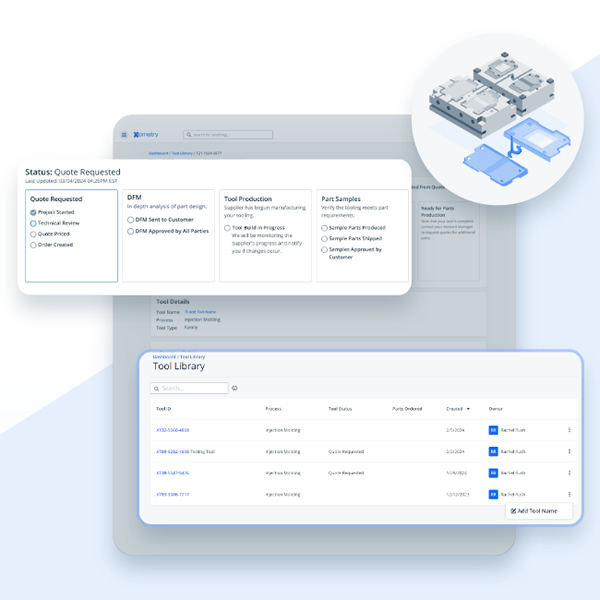
Xometry's platform has built-in features that make managing tooled projects a breeze, giving customers greater transparency into production. Find all your tooling quotes and orders in one space with your Tool Library. From there, you can explore their Tool Details page, which covers the current status, milestones, tool specifics, and activity related to that tool. You can also easily find and contact the Xometry team member assigned to your project, no matter the project's current phase.
Our Tool Library and Tool Details pages provide multiple benefits, such as:
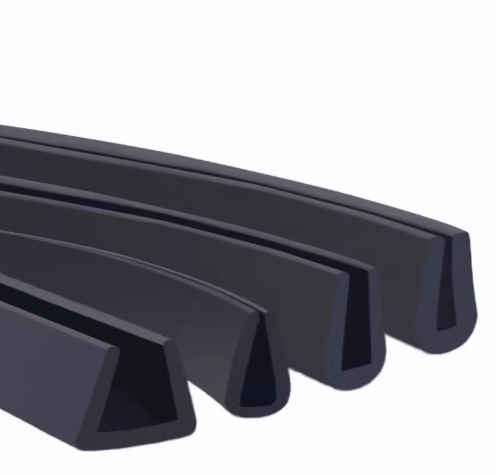
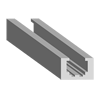
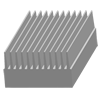
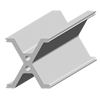
Plastic extrusions can be formed into open or closed cross-sections based on requirements. Round and square profiles are most common, widely used in tubing and piping systems, typically following industry standards to ensure compatibility with fittings and accessories. Closed profiles support up to 4 independent lumens for internal space partitioning. Open cross-sections include U-shaped, J-shaped, L-shaped channels and various custom profiles.
Plastic extrusion technology permeates nearly all industrial sectors. The following are representative application directions:
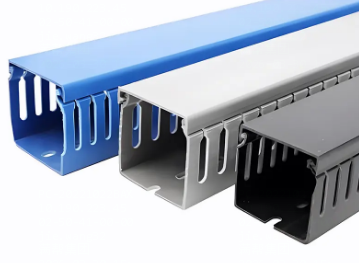
Plastic conduits protect electrical wires and transmission lines, providing additional insulation and physical protection. Residential, commercial and industrial facilities all extensively use these products. Compared to traditional metal conduits, they effectively reduce the risk of accidental short circuits.
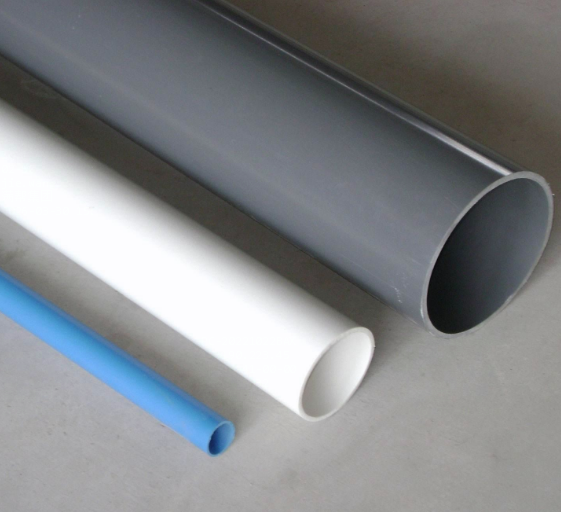
In industrial settings, extruded piping is widely used to transport water, wastewater and other liquid media. Compared to traditional materials like copper, cast iron and steel, plastic offers excellent chemical stability and resists corrosion when in contact with water or chemicals, making it an upgrade choice for piping systems and irrigation facilities.
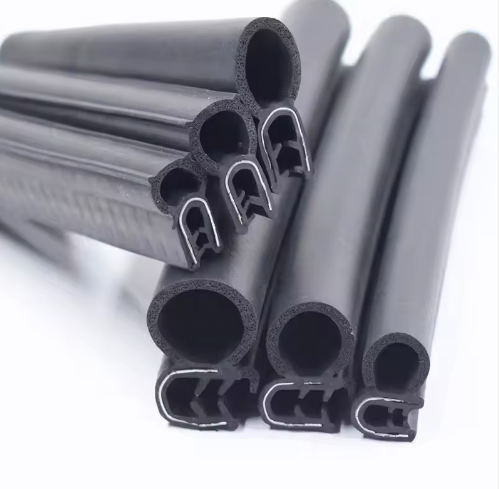
Seals, decorative trim and various irregular cross-section components are standard products of the extrusion process. These products protect part edges from damage and find widespread use in consumer products, automotive manufacturing and industrial equipment.
KH-TAT offers the following materials for custom plastic extrusions. If you don't find your required material in the list, please contact us through the manual quote process — we will assist with sourcing and arranging production.
LDPE is known for its balanced strength, controllable cost, semi-transparent appearance and chemical stability, commonly used for custom tubing and extruded profiles. While not suitable for open flame environments or prolonged outdoor exposure, it is widely used in food processing, especially for FDA-compliant flexible small-diameter tubing.
PEX, a cross-linked modified variant of HDPE (High-Density Polyethylene), excels in piping systems. Its cross-linked structure provides superior heat resistance and chemical stability compared to standard polyethylene, while retaining good processability and weldability. In residential plumbing systems, PEX offers cost advantages over copper pipe and is suitable for heating lines, sprinkler systems and drainage.
TPE combines the elasticity of rubber materials with the moldability of thermoplastics, serving as an effective alternative to latex, silicone rubber and other thermoset elastomers. Within rated temperature ranges, extrusion molded TPE offers oil and heat resistance, with customizable colors and hardnesses covering flexible to rigid applications. Common uses include fitness equipment handles, medical seals and various flexible components.
PVC stands out for its high strength, lightweight, easy processing and economic advantages, making it the mainstream choice for general-purpose extrusion materials. It finds application in residential plumbing systems and indoor/outdoor piping. Depending on operating conditions, modified variants such as CPVC, PVC-U and PVC-O can be selected to meet construction, structural and high-volume project requirements.
ABS offers a balanced combination of aesthetic quality, mechanical strength and availability, widely used in various plastic components. Extrusion molded ABS works well as decorative trim for appliances and equipment housings, and can also be used for water and sewer pipe systems. Additionally, ABS extruded profiles can serve as baseline materials for subsequent production processes, enabling designers to develop secondary features from a unified cross-section.
PS (Polystyrene) is known for its low cost, thermal insulation and processing convenience. Extruded PS (XPS) offers higher mechanical strength than expanded PS, suitable for ceiling insulation, refrigeration equipment, model making and craft applications.
PP has similar properties to polyethylene but with better cost advantages and higher temperature resistance. Its durability is demonstrated in the living hinge structure of shampoo bottle caps, and it easily achieves semi-transparent, opaque and multi-color designs. Extrusion molded PP is widely used in automotive tubing, toy components and food-grade hoses.
PC is valued for its impact resistance, temperature tolerance and controllable cost. Its dimensional stability and transparency make it suitable for impact-resistant windows, reusable water bottles, electronic components, personal protective equipment and rigid extruded profiles.

Choose from millions of combinations of materials, surface finishes, tolerance levels, marking methods, and certifications to flexibly match your order requirements for truly customized manufacturing.

No need to handle procurement, project management, logistics, or shipping yourself — we handle everything, parts arrive directly at your door, letting you focus on your core business.

KH-TAT is Certified to ISO 9001:2015, ISO 13485, IATF 16949:2016, and AS9100D, ensuring every part meets strict industry standards and quality requirements.
We use cookies to collect information about how you use this site. We use this information to make the website work as well as possible and improve our services.more details