Extrusion Process Overview
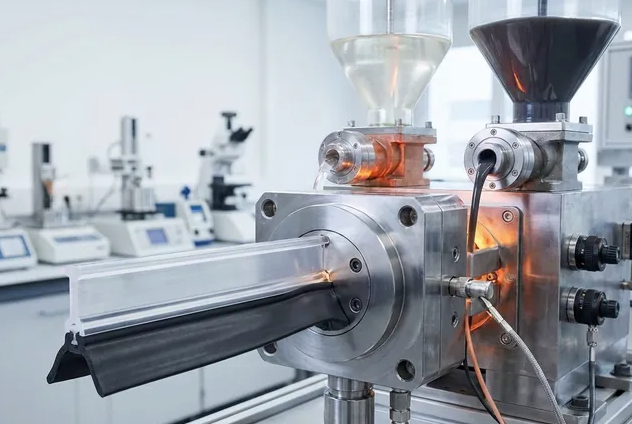
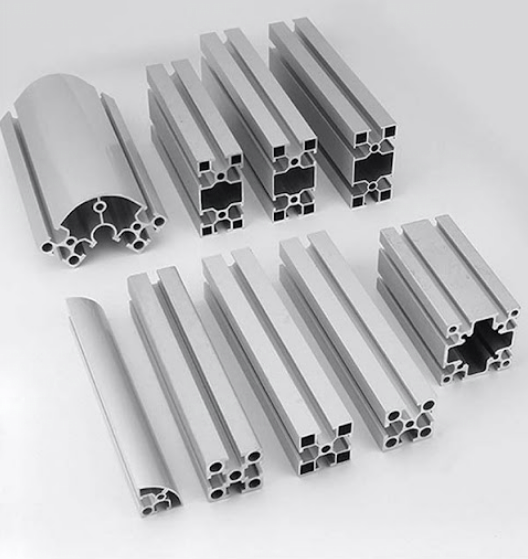
Metal extrusion is the preferred manufacturing process for producing large quantities of materials with constant cross-sections.During the extrusion process, the metal material is extruded through the forming opening of the die under high pressure to form an extrusion profile.These profiles come in a variety of shapes, from simple round or rectangular tubes, U-channels or H-channels, to complex profiles with multiple internal cavities and external features, such as 80/20 profiles and T-slot frame parts.Extrusion is also a standard process for wall trim and window frames, combining aesthetics and structural integrity.
The raw material is usually supplied in the form of billets, which are heated and then placed in the extruder container.The die set is located at the other end of the container, forming an opening, and the material is extruded into the desired shape through direct or indirect extrusion.The extruded part is then quenched, straightened, sawn to the specified length, and inspected for dimensional consistency and accuracy.The extruded product can also be post-processed to add other features to the outside of the profile.
Extrusion profiles can be formed into almost any shape, either solid or hollow.Hollow profiles may contain single or multiple hollow cross-sections and require multi-piece dies.The material is extruded in the first die to form the inner profile around the stamping mandrel supported in the die; after the material is separated, it is extruded or "welded" together in the second die to form the outer profile.The smallest arc that can enclose the profile determines the size of the extruder; the larger the circumscribed circle, the larger the required extruder size.
KH-TAT focuses on aluminum extrusion, with aluminum extrusions accounting for about 80% of all extruded metal parts.Aluminum extrusion profiles are widely used, from window frames and handrails to electrical enclosures, and are ubiquitous.
Our project managers and expert team will personally review and manually quote each metal extrusion project to ensure your unique needs are met while providing a fast and convenient manufacturing experience.
Metal Extrusion With Kh-tat

Start a Quote
Upload your files to the KH-TAT quotation engine and configure project parameters. Our team will communicate with you to ensure that specifications, delivery time, and price meet project requirements. Before starting mold manufacturing, we will provide a manufacturability design report for your approval.
Sample Approval
After the project starts, we will manufacture high-quality molds. Once the molds are completed, we will send you a sample of the parts (T1 sample) for your review and confirmation.l.

Production Start-up
After sample confirmation, mass production begins immediately and parts are delivered. KH-TAT handles supplier management and logistics coordination throughout the process. You own the molds and can reorder at any time as needed.
Built-in Tool Management
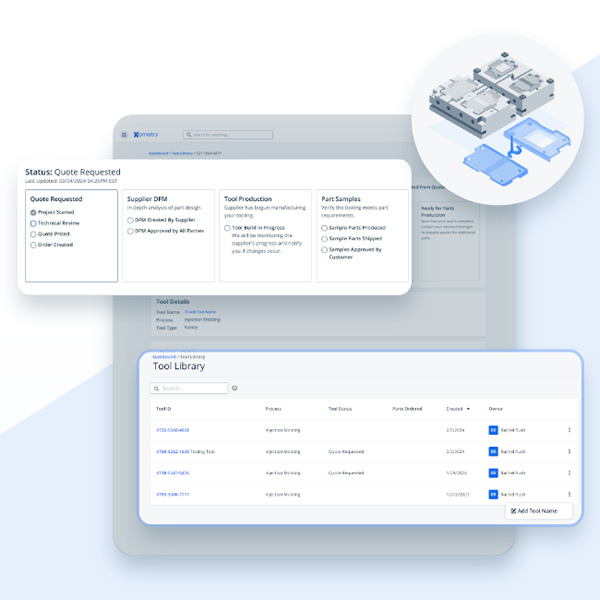
The KH-TAT platform incorporates multiple functions to simplify mold project management and enhance customer production transparency. Through the mold library, you can centrally view all mold quotes and orders in one space. The mold details page provides information on the current status, milestones, specific details, and related activities. Regardless of the project's stage, you can easily contact the KH-TAT team members responsible for your project.
The tool library and tool details page offer several advantages:
- More efficient management of tool quotes and orders
- Clear tool organization and categorization
- Detailed status updates and tool information
- Easy contact with the expert team
- Transparent and controllable project workflow
Extrusion Types and Profiles
KH-TAT collaborates with leading extrusion suppliers, utilizing advanced technology to provide high-quality extruded parts. Leveraging our manufacturing network, we support a wide variety of metal extrusion types and profiles.
Direct Extrusion:Direct extrusion (also known as forward extrusion) is the most common metal extrusion method. The billet is pushed into a container under high pressure by a piston, and the material flows in the direction of piston movement, being extruded from the opening of a fixed die. Compared to indirect extrusion, direct extrusion can achieve larger profile sizes and higher surface finishes.
The disadvantage is the greater friction between the material and the container wall, leading to reduced die pressure and temperature fluctuations, making dimensional consistency and material property control more challenging.
Indirect Extrusion:In indirect extrusion, the material is placed in and fixed in a container, and a hollow piston moves above the material, forcing it through the die opening. Also known as reverse extrusion, because the material flow direction is opposite to the piston movement. There is no relative movement between the material and the container, significantly reducing friction and energy consumption and heat generation. Compared to direct extrusion, it generates less heat and offers better dimensional consistency, material properties, and grain size control.
The disadvantage is the limited overall die size, as it must be housed within a hollow punch. Impurities on the billet surface may enter the extruded product, affecting surface finish and aesthetics.
Hot Extrusion, Warm Extrusion, and Cold Extrusion
Extrusion temperature, relative to room temperature and the material's recrystallization temperature, determines the extrusion method:
- Hot Extrusion: The billet is heated above the material's recrystallization temperature, typically associated with direct extrusion. Heating softens the material, preventing work hardening, facilitating flow through the die, and reducing die wear.
- Warm Extrusion: The material is heated above room temperature but well below the recrystallization temperature.
- Cold Extrusion: The material is not heated and remains at room temperature.
Cold and warm extrusion can improve product hardness and strength, and are best suited for highly ductile materials such as aluminum; they are typical examples of indirect extrusion. However, overheating should be avoided as it exacerbates die wear and shortens its lifespan; therefore, most manufacturers choose hot extrusion.
Extruded profiles refer to the cross-sectional shape that constitutes an extruded product. KH-TAT's custom manufacturing service can produce parts using custom extruded profiles, and can also perform post-processing on existing aluminum extruded profiles to save costs and time. Common existing profiles include:
- T-slot aluminum extruded profiles
- Aluminum angles
- T-beams, H-beams, Z-beams
- I-beams
- U-slots
- Cap-shaped slots
- Rectangular tubes
- Round tubes and pipes
Aluminum Profiles
Extruded aluminum profiles account for approximately 80% of all extruded metal products. Due to their wide range of applications, excellent mechanical properties, rich surface treatment options, and high ductility, they are ideal materials for extrusion processes. Most extruded aluminum alloys are lightweight, corrosion-resistant, and possess high thermal and electrical conductivity; each alloy has unique characteristics. Commonly used alloys include 6061 and 6063. For stainless steel or other metal extruded profiles, the quotation interface offers a "Custom Material" option; please submit your requirements.
Extruded Parts Surface Finish Options
- Extruded State: The surface remains as it was after extrusion, without any subsequent treatment. Surface roughness varies depending on the alloy and grain structure, typically ranging from 64 μin to 125 μin Ra. Noticeable grain lines or discoloration streaks may be present.
- Anodizing (Type II or Type III): Type II anodizing forms a corrosion-resistant oxide layer that can be dyed in transparent, black, red, gold, etc. Type III anodizing produces a thicker layer with both corrosion and wear resistance. Anodized coatings are non-conductive.
- Powder Coating: Powder coating is electrostatically sprayed and then baked to cure, forming a more robust, wear-resistant, and corrosion-resistant durable coating than traditional wet spraying. A variety of colors and textures are available to meet visual requirements.
- Wet Spraying: All extruded metal parts can be coated with paints of various formulations and colors. For more information... For color matching, please specify the paint brand and part number on the drawings or specifications.
- Electroplating: Extruded parts can be electroless plated with nickel, brass, tin, chromium, chromates, Teflon, silver, and gold.
- Chemical Film: Chromate conversion coatings protect aluminum from corrosion, improve paint and primer adhesion, and maintain the metal's conductivity.
- Tumbling: Parts are tumbled using a vibrating medium to remove sharp edges and smooth the surface. Suitable for small parts that can be placed in a tumbling machine.
- Custom Surface Treatments: If the desired surface treatment is not found, please select "Custom" on the quotation page and inform us of your requirements. We will explore more options for you.
Advantages
Dimensional Accuracy and Stability: Modern extrusion presses and processes produce extruded profiles with small tolerances, durability, and dimensional stability, suitable for both brittle and ductile materials.
Low Part Costs: Through careful design, extruded frames and shells eliminate multiple assembly steps, easily achieving high-volume and cost-effective production.
Low Die Costs: The extrusion process is relatively simple, and die costs are 80-90% lower than other processes such as injection molding or die casting.
High Part Complexity: Extrusion molding is ideal for manufacturing parts with complex cross-sectional shapes, including features such as undercuts, T-slots, and grooves.
Disadvantages
Initial Setup Costs: In addition to the unit price of the extruded part, die and tooling manufacturing incur additional costs, reflected in tooling and setup fees.
Design Limitations: The cross-section of the extruded part must remain constant, limiting design freedom. Features such as countersunk holes, grooves, or bosses cannot be extruded and require additional post-processing.
Delivery Cycle: The number of extrusion molding manufacturers is relatively small, and die production and iteration cycles can take several months. As a result, the delivery cycle for the first batch of parts is typically four to six weeks.
Ready to get started on your extrusion quote?
Metal Extrusion Applications
Metal extrusion products are widely used in daily life and industrial production. From metal door and window frames to building structural components and aircraft parts, extruded profiles are ubiquitous. Metal pipes, shaped bars, and angle steel are all manufactured through extrusion processes, and many custom parts are processed from standardized extruded profiles.
Metal extrusion is often the best, and sometimes only, method for large-scale manufacturing of parts with continuous complex cross-sections while maintaining economic efficiency. This process is widely used in industries such as automotive, aerospace, shipbuilding, construction, food processing, and electronics.
Typical applications include:
- Aircraft structural components
- Window frames, door frames, and trim strips
- Electrical connector housings
- Conveyor belt assemblies
- Ladders and scaffolding
- Complex thin-walled enclosed structures
- Radiators
Why Choose Kh-tat for Extrusion Services?

Endless Options
Choose from millions of possible combinations of materials, finishes, tolerances, markings, and certifications for your order.

Easy to Use
Get started with our easy-to-use platform and let our experts take care of managing the project from locating the right manufacturing partner to delivery logistics.

Vetted Network
We are ISO 9001:2015, ISO 13485, and AS9100D certified. Only the top shops that apply to become suppliers make it through our qualification process.