Start a New CNC Turning Quote
STEP | STP | SLDPRT | STL | IPT | 3MF | 3DXML | PRT | SAT files and more!
Share drawings, sample photos, dimensions, or project notes and our team will follow up with a manufacturing review.
CNC Turning with KH-TAT
KH-TAT has an extensive network of 5,000+ machining shops, including specialists equipped with CNC lathes and turning centers, providing the capacity and capabilities your project needs while ensuring the most competitive pricing and lead times. Our machine learning-based platform provides instant manufacturability feedback,Ensuring your parts are optimized for CNC turning processes,Meets all technical requirements。
Our on-demand manufacturing platform provides high-quality metal andPlasticsCNCTurned Parts,Suitable forRapid PrototypingAnd various production needs from low to high volume。Upload Now3D CADFile,Get an Instant Quote。Turning prototype prices include tariffs and standard package shipping.
Xometry CNC Materials
| Material | Available Varieties |
|---|---|
|
Aluminum |
Aluminum 5052, |
|
Brass/Bronze |
Brass C360, |
|
Copper |
EPT Copper C110, |
|
Plastics |
ABS, |
|
Steel |
Alloy Steel 4130, |
|
Titanium |
Titanium Grade 2, |
|
Zinc |
Zinc Sheet Alloy 500 |
Additional alloys and tempers are available upon request. We can source to your project specifications.
Custom Material Options
We offer variousCNC turning metal and plastic material options,Get instant online quotes。If desired not foundMaterials,Please on the quote pageMaterialsSelect from dropdown menu“Other”,Fill in part features、Tolerance、Inspection requirements and quantity then submit,Our engineering team will review for you。
Finishes

Ready to get started on your CNC turning quote?
Free shipping available for domestic CNC machining orders
Applications of CNC Turning

Rapid Tooling
CNC technology can be applied to almost all materials, making it ideal for rapid tooling, such as manufacturing jigs, fixtures, and other tooling components to meet fast-response production needs.
Rapid Prototyping
Wide material selection, low per-unit machining costs, and fast production speeds make CNC machining ideal for prototyping, supporting rapid product validation and iteration.

Batch Production
High-quality surface finishes, extensive material options, and precise tolerance control make CNC turning the preferred technology for batch production parts, meeting various industrial application needs.
Advantages of CNC Turning
CNC General Tolearances
| Description | General Tolerance |
|---|---|
|
Distance Dimensions |
For features of size (Length, width, height, diameter) and location (position, concentricity, symmetry) +/- 0.005”. |
|
Orientation and Form Dimensions |
0-12" +/- 0.005", Angularity 1/2 degree. For 24" and beyond please consult Xometry's Manufacturing Standards. |
|
Edge Condition |
Sharp edges will be broken and deburred by default. Critical edges that must be left sharp should be noted and specified on a print. |
Please check out Xometry's Manufacturing Standards for more information on tolerances per process. Unless we have agreed to other tolerances in your Quote, we will work to achieve and hold the tolerances noted.
Overview: What is CNC Turning?
CNC Lathe Basics
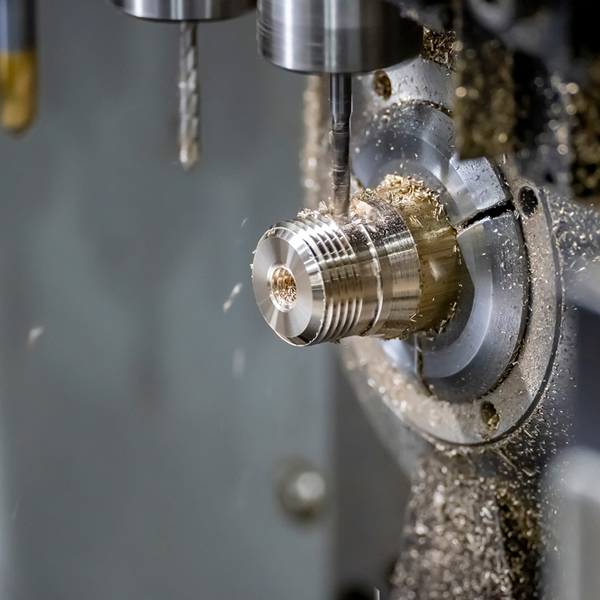
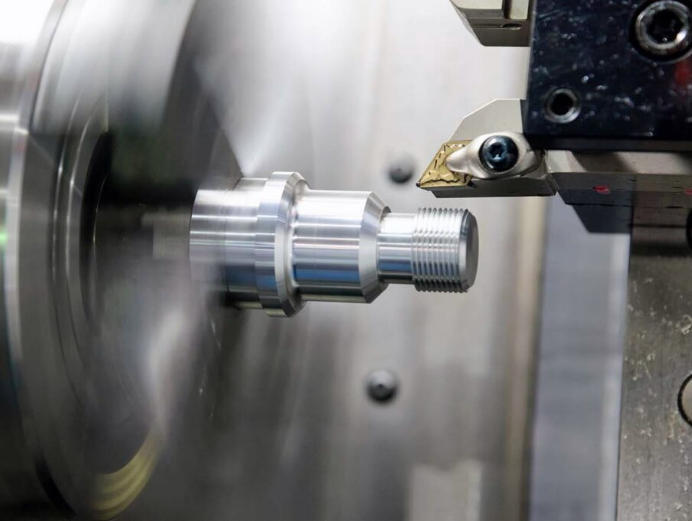
CNC lathes, also called live-tool lathes, are ideal for machining symmetrical cylindrical or spherical parts. Their core feature is the workpiece rotating around a vertical or horizontal axis while fixed tools move along approximately linear paths around the workpiece. The process of machining workpieces on a CNC lathe is called turning.
How CNC Turning Works
CNC turning uses a subtractive manufacturing methodManufactures desired shape。GeneratesGAfter code,BlankMaterialsLoaded into the lathe spindle chuck,The chuck secures the workpiece and drives spindle rotation。When spindle reaches set speed,Fixed cutting tool contacts the workpiece,Gradual cuttingMaterialsUntil reaching predetermined geometry。
Lathes with live tooling can perform multiple machining operations,Including facing operations、Threading、Knurling、Drilling、Boring、Reaming and taper turning。Different operations require tool changes,Increases cost and setup time。
After all operations complete,Parts cut off from the blank,Enters subsequent post-processing。CNC lathes can quickly repeat the same operation,With almost no additional setup time in between。
Types of CNC Lathes
Various lathe types,Most common are dual-axis CNC lathes and Swiss lathes。
Swiss lathes are unique in that the workpiece feeds through a guide bushing,Allows cutting closer to the support point,Especially suitable for slender part machining andMicro Machining。Some Swiss lathes feature a second tool head,Can serve asCNC millingBed uses,Multiple operations can be completed without moving the workpiece to other equipment,Significantly improves machining efficiency and cost-effectiveness for complex turned parts。
CNC turning process advantages
AndCNC millingSimilar to bed,CNC lathes are easy to set up with high repeatability,Suitable forRapid PrototypingAnd low to high volumeBatch Production。Multi-axis CNC turning centers and Swiss lathes allow multiple operations on a single machine,Is a cost-effective choice for complex geometry part machining,Whereas traditional mills require multiple machines or frequent tool changes for the same result。
Types Of CNC Lathes
There are many types of lathes, but the most common are 2-axis CNC lathes and Swiss-type lathes. Swiss-type lathes are unique in that stock material is fed through a guide bushing, allowing the tool to cut nearer to the point of support, which makes them particularly useful for long, slender CNC lathe parts and micromachining. Some Swiss-type lathes also come equipped with a second tool head that operates as a CNC mill, allowing them to perform multiple machining operations without having to move the workpiece to a different machine. This makes Swiss-type lathes extremely cost-effective for complex turned parts with CNC lathe services.
Benefits Of CNC Turning
Like CNC mills, CNC lathes can be easily set up for high repeatability, which makes them great for everything from rapid prototyping to low and high-volume production. Multi-axis CNC turning centers and Swiss-type lathes allow for multiple machining operations in one machine. making them a cost-effective option for complex geometries that would otherwise require multiple machines or tool changes in a traditional CNC mill.
There are many types of lathes, but the most common are 2-axis CNC lathes and Swiss-type lathes. Swiss-type lathes are unique in that stock material is fed through a guide bushing, allowing the tool to cut nearer to the point of support, which makes them particularly useful for long, slender CNC lathe parts and micromachining. Some Swiss-type lathes also come equipped with a second tool head that operates as a CNC mill, allowing them to perform multiple machining operations without having to move the workpiece to a different machine. This makes Swiss-type lathes extremely cost-effective for complex turned parts with CNC lathe services.